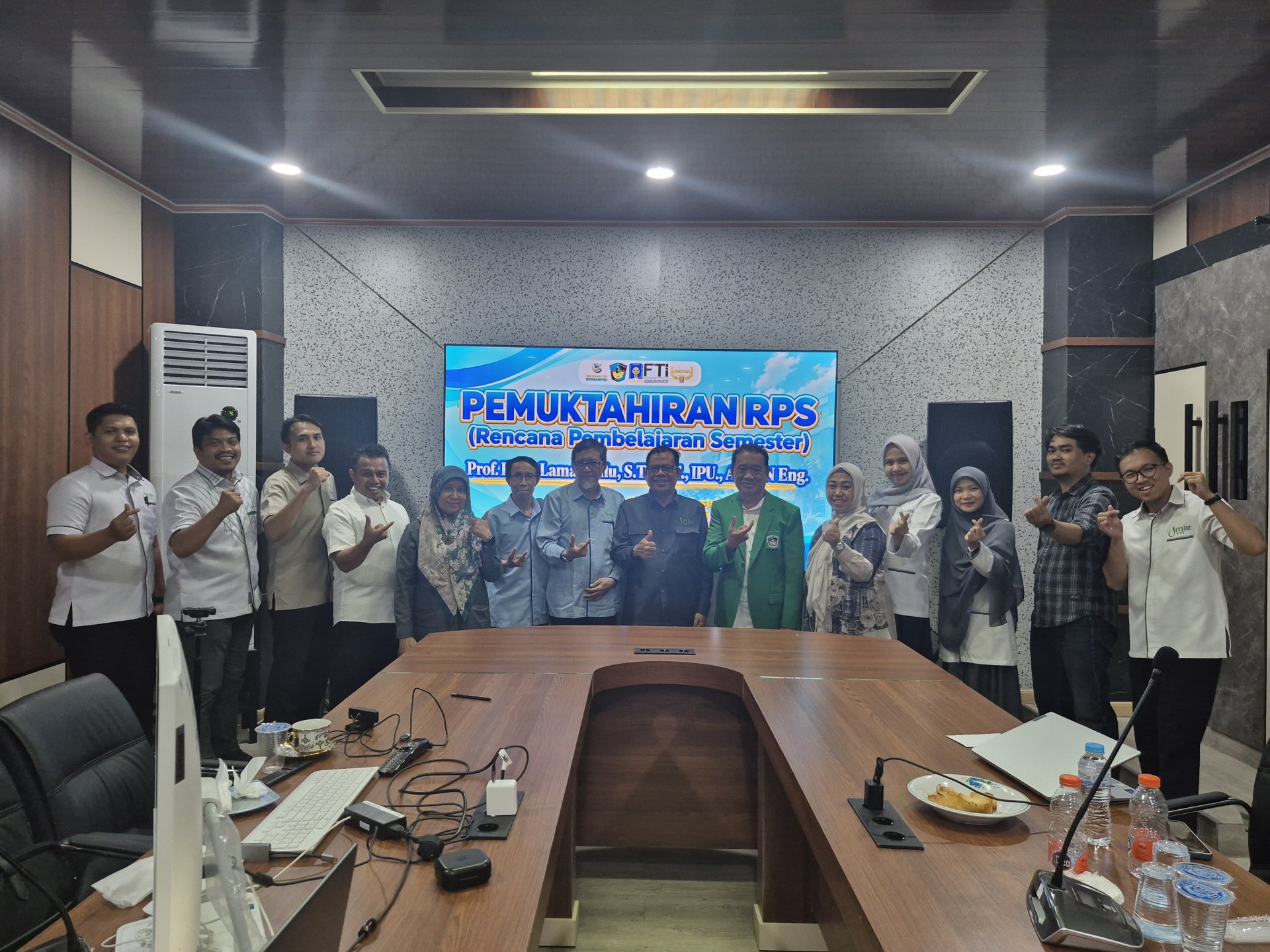
This commitment was demonstrated through an initiative to update the curriculum and the Semester Learning Plans (RPS), held in the 2nd-floor meeting room of the UMI Faculty of Industrial Technology on Monday (September 14, 2026).
The event featured two speakers with extensive experience and established reputations in curriculum development and higher education quality assurance: Prof. Dr. Ir. Elisa Kusrini, M.T., CPIM., CSCP., SCOR-P, from the Faculty of Industrial Technology at Universitas Islam Indonesia, and Prof. Dr. Ir. Lamatinulu, S.T., M.T., IPU., ASEAN Eng., from Universitas Muslim Indonesia.
Participants included lecturers from the undergraduate and master's Industrial Engineering programs, administrators of the Professional Engineer Program, and a number of alumni who joined online to provide input on the direction of curriculum development.
The Head of the UMI Industrial Engineering Study Program, Ir. Andi Pawennari, S.T., M.T., IPU., ASEAN Eng., emphasized that updating the curriculum and RPS is not merely a matter of fulfilling accreditation requirements; rather, it is a way for the study program to ensure that its educational activities remain on the right track.
“We are undertaking this update to ensure that UMI’s Industrial Engineering program stays on the right track. The curriculum and course syllabi are the instruments we use to guarantee that graduates truly achieve the learning outcomes we have promised to the public and the professional world,” he said.
According to Ir. Andi Pawennari, standardizing the grading system across courses is an urgent matter requiring a collaborative approach; this also involves aligning with the outcomes of the congress held by the Cooperation Body for Industrial Engineering Higher Education Providers (*Badan Kerja Sama Penyelenggara Pendidikan Tinggi Teknik Industri*), which serves as the national benchmark for the discipline.
In her presentation, Prof. Elisa Kusrini explained that today’s industrial engineering curriculum faces two major, rapidly advancing trends: sustainability and digitalization. Both require integration into all areas of study rather than existing merely as standalone courses.
“Current demands for sustainability are driven by regulations, compelling companies to report on these matters to the public. The question is, are our graduates confident enough to enter the industrial world equipped with knowledge of sustainability and digitalization?” she explained.
She also highlighted the importance of a distinctive academic vision that is consistently reflected in graduate profiles, learning outcomes, expertise groups, and laboratories, as well as in faculty research and community service activities. In her view, a well-structured academic track record is a key determinant of success in a lecturer's academic career development.
“That track record must be cultivated, and it stems from one's area of expertise. When a lecturer's expertise is well-organized, the direction of their research, community service, and teaching will reinforce one another,” she stated.
Prof. Elisa Kusrini shared best practices for strengthening industry relevance through schemes such as practitioner-lecturer grants, student-authored book chapters, and scientifically rigorous competitions designed from the outset, as well as collaborative research and international publication opportunities open for development with FTI UMI.
Meanwhile, Prof. Lamatinulu outlined the implications of regulatory changes on the design of Semester Learning Plans (RPS), specifically referencing the Regulation of the Minister of Higher Education, Science, and Technology Number 39 of 2025, which was subsequently updated to Ministerial Regulation Number 10 of 2026.
According to her, the latest regulations allow for greater flexibility in drafting the RPS but mandate the development of five key learning characteristics: enjoyable, inclusive, collaborative, creative, and effective.
"In terms of format, the Industrial Engineering RPS already meets the standards. What we need to focus on together is how to internalize student-centered learning; without it, our RPS cannot truly be considered 'Outcome-Based Education' compliant," she emphasized.
She advocated for the use of case-based learning, project-based learning, and gamification, alongside the utilization of the 'Kalam' learning management system to enhance both in-person and online classes. She also highlighted the need for lecturers to shift their roles toward becoming facilitators, innovators, motivators, and sources of inspiration.
The session, moderated by Dr. Ir. Ahmad Padhil, S.T., M.T., IPM., AER, was highly interactive, featuring questions from participants—including Dr. Taufik Nur, S.T., M.T., IPU.—regarding the distinctiveness of the academic vision and the benchmarks for international competitiveness in accreditation assessments.
The discussion expanded to cover the relevance of graduate profiles for the next five years, the strengthening of the study program's unique identity, mechanisms for involving industry practitioners, and opportunities to enhance foreign language proficiency as a value-add for graduates in Eastern Indonesia.
As a follow-up measure, the Industrial Engineering Study Program will establish a curriculum workshop team tasked with reviewing graduate learning outcomes via tracer studies, involving alumni, employers, and academic associations in a phased approach. For the Industrial Engineering Study Program at FTI UMI, this initiative serves as a platform to align government regulations, industry demands, and best practices from other higher education institutions, while simultaneously reinforcing a culture of continuous improvement in educational delivery.
Through this activity, FTI UMI once again demonstrates its role as a faculty committed to constant evolution, enhancing the quality of learning, and preparing a generation of engineers capable of addressing the challenges of sustainability and digitalization.
For UMI, engineering education is about more than just drafting curriculum documents.
It is about ensuring that every student truly achieves the promised learning outcomes. Universitas Muslim Indonesia is a Campus of Knowledge and Worship, a Campus of Struggle and Service, and a Campus of Reputation and Impact.