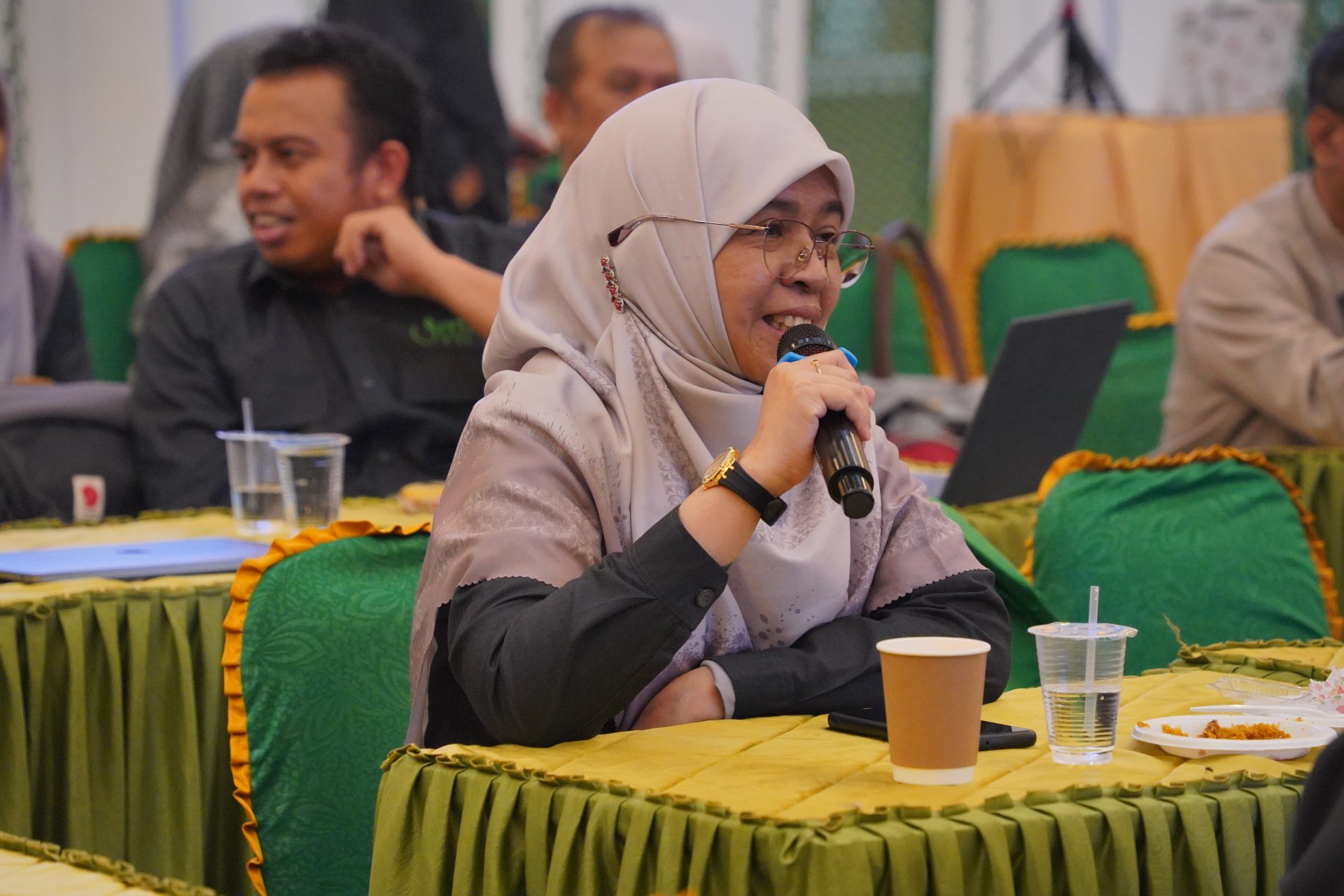
MAKASSAR – The Faculty of Industrial Technology at Universitas Muslim Indonesia (FTI UMI) held its 2026 Work Meeting at the Al-Jibra Auditorium, Universitas Muslim Indonesia, Makassar, on Wednesday, October 14, 2026. The event served as a strategic forum to align policy directions, evaluate the faculty’s development needs, and formulate work programs that respond to technological advancements and the evolving landscape of higher education.
This year’s work meeting carried the theme, “Transforming FTI through Digitalization, Excellent Human Resources, Integrity, and Islamic Values toward Sustainable Innovation and Global Competitiveness.” The theme reaffirms FTI UMI’s commitment to establishing an excellent higher education environment through the utilization of digital technology, the improvement of human resource quality, the strengthening of integrity, and the implementation of Islamic values across all aspects of educational delivery.
In his remarks, the Rector of UMI, Prof. Dr. H. Hambali Thalib, S.H., M.H., emphasized that faculty work programs must be oriented toward students’ needs and support the achievement of the university’s strategic objectives. He stressed that programs should not merely follow annual routines but must instead be developed based on problems that need to be addressed, their level of urgency, and the benefits they can deliver in improving educational quality.
The Rector also encouraged a shift in the approach to program planning, ensuring that every initiative has clearly defined objectives and measurable outcomes. Through this approach, program implementation is expected to improve the quality of learning, strengthen students’ competencies, optimize academic services, and make a tangible contribution to institutional advancement.
Digital Transformation and Human Resource Competency Development as Strategic Priorities
Digitalization is one of the main priorities in FTI UMI’s development agenda. This transformation extends beyond the use of applications and online services to include information system integration, workflow simplification, improved data accuracy, and faster academic and administrative services.
This direction aligns with Universitas Muslim Indonesia’s vision of transforming into a Smart Islamic AI-Driven University through UMI Connection. This initiative promotes the integration of services and data based on four principles: One Access, One Data, One Process, and One Leadership Dashboard.
Within FTI UMI, the implementation of digital systems is expected to improve the effectiveness of management across various areas, including academic activities, laboratories, research, student affairs, finance, and administration. The optimization of technology is also expected to facilitate the work of the academic community while enhancing the quality of services provided to students.
Alongside digital transformation, human resource development remains an inseparable priority. Lecturers and educational staff are encouraged to continuously improve their expertise, professionalism, integrity, and ability to adapt to technological changes and evolving workplace demands.
Advances in artificial intelligence, automation, and industrial innovation require FTI UMI to remain adaptive and forward-looking. Therefore, strengthening human resource capacity is intended to support improvements in teaching and learning, research productivity, innovation development, and graduate competencies.
These efforts are expected to remain grounded in Islamic values, professional ethics, responsibility, and a spirit of collaboration, ensuring that technological progress goes hand in hand with character development within the academic community.
FTI UMI Dean Emphasizes Program Alignment and Improved Faculty Performance
The Dean of FTI UMI, Prof. Dr. Ir. Andi Suryanto, S.T., M.T., IPM., ASEAN Eng., positioned the 2026 Work Meeting as a consolidation forum to establish a shared understanding of policy directions and development priorities across all areas of the faculty.
The work program planning process focuses on several key agendas, including improving academic quality, developing the competencies of lecturers and educational staff, strengthening research and innovation, expanding partnerships with industry, developing digital services, and enhancing student development programs.
Each division is expected to formulate coordinated and mutually supportive initiatives to achieve the faculty’s objectives. Priorities are determined by considering institutional needs, resource availability, budget efficiency, and the direct benefits that can be delivered to students and the broader academic community.
Through this approach, work programs are positioned not merely as administrative planning documents but also as strategic implementation guidelines for continuously and sustainably improving the quality of higher education.
Five UMI Vice Rectors Share Insights in Panel Discussions
As part of efforts to align faculty programs with university policies, the 2026 FTI UMI Work Meeting featured five UMI Vice Rectors who participated in two panel discussion sessions.
The first panel featured the Vice Rector I of UMI, Prof. Dr. Ir. H. Dirgahayu Lantara, M.T., IPM., ASEAN Eng., and the Vice Rector II of UMI, Prof. Dr. Ir. H. Zakir Sabara HW, S.T., M.T., IPM., ASEAN Eng., APEC Eng. The session was moderated by the Vice Dean I of FTI UMI, Dr. Ir. Ruslan Kalla, S.T., M.T., IPM., ASEAN Eng.
The second panel featured the Vice Rector III of UMI, Prof. Dr. H. M. Kamal Hijaz, S.H., M.H.; the Vice Rector IV of UMI, Dr. KH. M. Ishaq Shamad, M.A.; and the Vice Rector V of UMI, Ir. Hj. Setyawati Yani, S.T., M.T., Ph.D., IPM., ASEAN Eng. The session was moderated by the Vice Dean III of FTI UMI, Ir. Firmanullah Yusuf, S.T., M.T., IPM.
The forum provided an opportunity to strengthen communication between university and faculty leadership while aligning development priorities in academic affairs, financial and resource management, student affairs, character development, and institutional development.
Following the panel discussions, the meeting continued with a plenary session to discuss proposed work programs covering the areas of vision and mission, academic affairs, finance, student affairs, and character development.
Measurable Programs to Build a Globally Competitive Faculty
The 2026 FTI UMI Work Meeting is expected to produce well-planned, realistic work programs supported by clear evaluation mechanisms. Each program should include achievement targets, designated persons in charge, budget allocations, performance indicators, and measurable benefits to ensure that implementation can be monitored and evaluated objectively.
Development priorities are directed toward various areas that contribute to improving teaching and learning quality, strengthening student competencies, enhancing accreditation quality, advancing research, promoting technological innovation, and aligning graduate competencies with industry needs.
This agenda also refers to the Catur Dharma of UMI, as stipulated in the 2024 UMI Statute, which encompasses Education and Teaching, Research, Community Service, and Commitment to UMI and Character Education.
Through the 2026 Work Meeting, FTI UMI reaffirms its commitment to strengthening collaboration across all faculty units to establish effective governance, foster a culture of integrity, and develop an innovative academic environment grounded in Islamic values.
Ultimately, the success of the work meeting will not be measured solely by the completion of program documents but also by the consistency of implementation and the tangible impact achieved. Through planning that prioritizes students’ needs, human resource development, digital technology optimization, and efficient budget management, FTI UMI is expected to continue growing, address the challenges of higher education, and strengthen its position in an increasingly competitive global environment.